
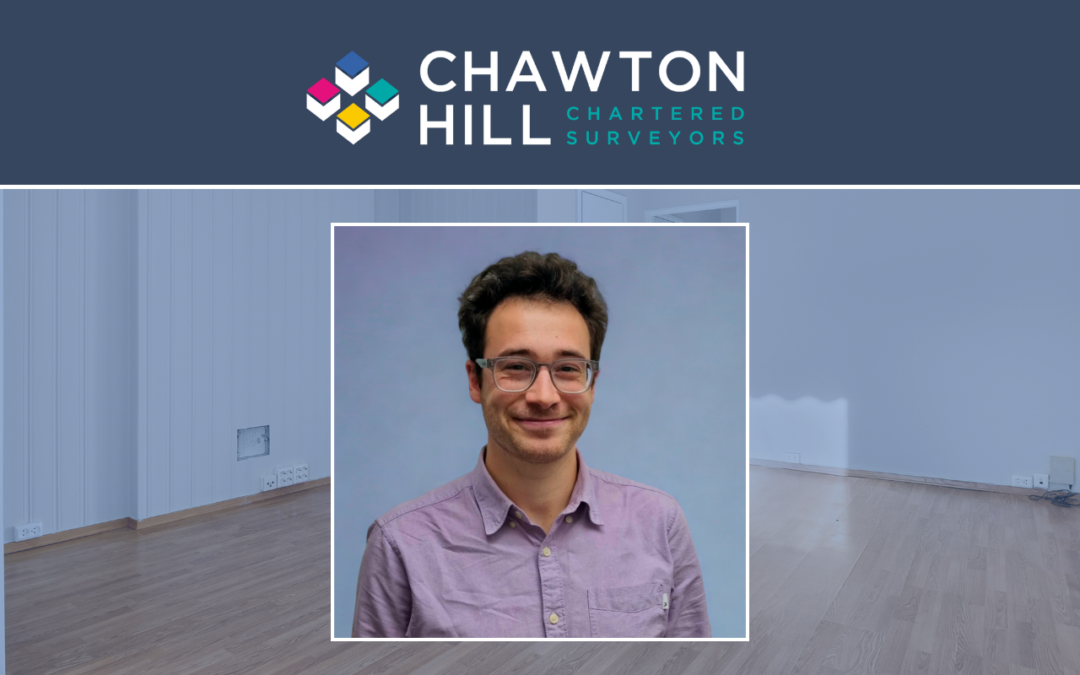
Oran Green is a graduate surveyor at Chawton Hill. His role is to assist with producing design proposals and pre-construction information documents, conducting on-site inspections and surveys, cost planning and producing programmes of works. We sat down with Oran to find out a bit about him and his career.
Tell us a bit about your education, background, and what inspired you to pursue a career in construction?
It was a natural choice for me. I grew up in Leeds and started “working” around 12 years old, washing cars with a little trailer I’d constructed myself. Gaining the slight financial independence as a kid gives you a drive.
At 14, I started working during school holidays for my uncle’s furniture factory. There, I spent my time assembling various pieces of furniture until I was 18 and had finished my A-levels. I also worked with my father at weekends laying floors. I therefore learnt to install flooring, it became my trade. This helped me through university, I’d get odd jobs to increase my budget.
My younger life revolved around construction, using tools and being on site. When I found out about building surveying whilst studying for my A-levels it seemed like a natural choice. I always quite fancied being a doctor but wasn’t quite sure that lifestyle would fit and 7 years of studying was definitely not my ideal. When I thought about what appealed to me, it was the idea of diagnosing a problem and prescribing the right remedy. So, I applied that thinking to construction. Surveyors do exactly that with buildings, and I fell in love with the idea.
Brighton Bound…
I studied building surveying at Brighton (as did Joe another team member, but started a couple of years after me). I studied part-time for the last two years of my degree and worked part-time for a flooring firm in project management, managing their large-scale commercial installs in London. I thought this would give me some key management experience which would come in handy when I transferred into the building surveying profession. I stayed there for three years after graduating.
I’ve worked on some interesting projects, including the world’s largest modular residential building College Road Enclave. I completed around eight of these projects in the five years I was working with that contractor.
Once I finished my degree, I had arranged to finish a certain number of projects for my previous director. Then I started on my surveying career. My previous director had always known this was my plan and was incredibly supportive throughout my time with his firm. So once the last project finished (Enclave, North Acton) in October last year, I moved to Chawton Hill.
What’s it like working at Chawton Hill?
Fantastic for me. We’re very busy and I’m getting experience with every aspect of surveying. It includes some quantity surveying work, site inspections, surveys, and a bit of project management with Fai Ko, one of our senior project managers.
The guidance and support is something I really value. Dave and James let you crack on with the job but always have an eye on you in case things go off track, then they’ll jump in. Mostly, they allow you enough time to figure it out yourself before jumping in which really gives you room to grow your expertise.
We work in an open plan office which promotes a lot of learning whilst you work which is great as a graduate surveyor. If I need clarification from a senior member, it’s very easy to ask a question. Team morale is high, which is really important when you’re working in such an environment this being one of the big reasons I look forward to coming to work every morning.
Do you have a most interesting project so far?
Each project comes with its own challenges. Previously, working on flooring packages on modular buildings involved a lot of problem solving. Modular buildings have tolerances and can shift vertically which can make laying floors tricky. We had to design specialist tools and use a lot of maths to solve those issues. That was always interesting.
At Chawton Hill, every survey brings something different. As a surveyor, you’re always asking why issues are occurring. On a recent school project, a perimeter wall had problems, and we needed to work out why. It turned out a retro fitted fence was installed to the top of an existing wall that wasn’t designed for it. This caused movement, opening points for weathering, leading to plants growing in the cracks and causing more movement. Once we had established the problem, we were able to recommend a solution.
Searching for Water…
On another project, we were investigating how moisture was making it through from the external leaf to the internal leaf of an accommodation block for an independent school. I was up on a boom lift, evaluating some elevations for the boarding houses. We were trying to work out where the water was coming from. It wasn’t the roof system everything looked good. So where was it coming from? We moved to investigating the masonry walls and cavity spaces to see if there issues with these elements of the elevation.
Upon investigation the masonry seemed fairly porous and fractured to the surface. There was a lot of debris on cavity trays, which protects the openings of doors and windows and stops water seeping down. It was possible that moisture was making It through the surface damaged brick work to the internal face of the cavity space and the debris could cause water to pool and moisture to collect. It took two days of investigation to confirm and diagnose these issues – 30 metres in the air.
You’re currently working towards your RICS chartership. How’s that going?
I’ve signed up as a member and I’m proactively working towards it but haven’t formally started the process yet.
It’s something I’m very keen to do. Chartership demonstrates you can work at a certain standard and that clients can trust what you say. Trust is important. A lot of the buildings are people’s homes and many of the commercial buildings we work on are incredibly important to communities and charities. You can’t guess with buildings, you have to be able to tell them how we are going to fix things. It can be disastrous if you make the wrong decision.
RICS qualification gives people that confidence. It’s the next natural step to build me into the surveyor I want to be and become chartered. It’s a lot of work, because you need to prove you have the knowledge and experience to make these decisions. However, I’m looking forward to the challenge.
Can you tell us the most valuable lesson you’ve learnt as a graduate surveyor?
Having spent 3 years as a project manager after graduating my degree I would say the most valuable lesson I have learnt and still continue to learn is how to think like a surveyor when approaching sites and how to conduct yourself as surveyor around clients.
You come out of university and start going on surveys, but every company develops its own processes. Every survey you’re learning. Every building is different.
For example, on a recent quinquennial survey for a Catholic church with James, there were loads of features I’d never seen before or had to describe. Watching how he tackled it and receiving guidance from him was great. Even how to describe specific features when you don’t know the exact terminology at the time. You can find that out later once your back at the office and update the report as long it is referred to accurately. The importance is the methodological process.
And the greatest skill? How to carry as many cups of tea or coffee at once from the kitchen to the office!
What advice would you give someone thinking about a career in construction?
It depends on which aspect of construction they’re interested in. If you’re looking for a professional career, I’d say look into a degree apprenticeship rather than just going straight to university.
Having site experience really makes you stand out. You learn how to conduct yourself in a real-world environment, you learn how to do the job rather than just the information to do the job and you get paid. This experience is so valuable and something you do not get from just going to university. My advice, get on the job as soon as you can and start learning.
Finally, what do you enjoy outside of work?
I’m just about to move into a new house with my fiancé, which is taking up a lot of my time at the moment.
In general, I’m quite active. I run a fair amount; I’m currently training for a half marathon in May and an ultra-marathon in September. I might try and get another one in at the end of the year too, but that’s pretty ambitious for someone who has never done one before! My fiancé has done five or six and an ultra, and we’re quite competitive.
I do a lot of hiking. I completed the Yorkshire Three Peaks last summer and I’m doing the Surrey Three Peaks in April as training for a 50km hike in the lake district in the summer. I started learning to play the piano two years ago. It’s always something I wanted to do for a while and thought what’s stopping me? I play a game called ultimate frisbee for a team in Epsom. I’ve also got a dog who I spend the rest of my time with, he joins us for hikes and a few runs and also loves his frisbee!
Find out more about Oran and contact him here.